One month, four countries, and less money than most people spend on rent: this is the classic Southeast Asia loop, and it remains the best-value adventure on the planet. The route runs Thailand to Laos to Vietnam to Cambodia — overland the whole way, no internal flights required — and a realistic total is $800–1,000 for the month, everything included once you've landed in Bangkok. Here's the week-by-week plan with real prices, the border crossings explained, and an honest breakdown of where every dollar goes.
The route at a glance
Bangkok → Chiang Mai → Chiang Rai → slow boat to Luang Prabang → Vang Vieng → Vientiane → Hanoi → Ha Long Bay → Hoi An → Ho Chi Minh City → Phnom Penh → Siem Reap, then a cheap flight or bus back to Bangkok. It flows in one direction, every leg is a well-worn backpacker run, and you're never more than a night bus from the next stop. Daily budget target: $28–33, with Laos cheapest and the Vietnamese cities the best value for what you get. Running the loop in this direction also puts the hardest travel day — Laos into Vietnam — in the middle of the month, when you're travel-fit, and saves the easy wins of Cambodia for the final, tired week.
Two notes before you book anything: the loop needs the full 28 days to avoid becoming a bus tour, and the visa arithmetic totals about $90–100 (Laos on arrival, Vietnam's e-visa in advance, Cambodia on arrival). Fly into Bangkok on a one-way ticket with proof of onward travel handled — a $25 Siem Reap–Bangkok bus booking satisfies most airline check-in desks and conveniently becomes your actual final leg.
Week 1: Thailand — Bangkok and the north
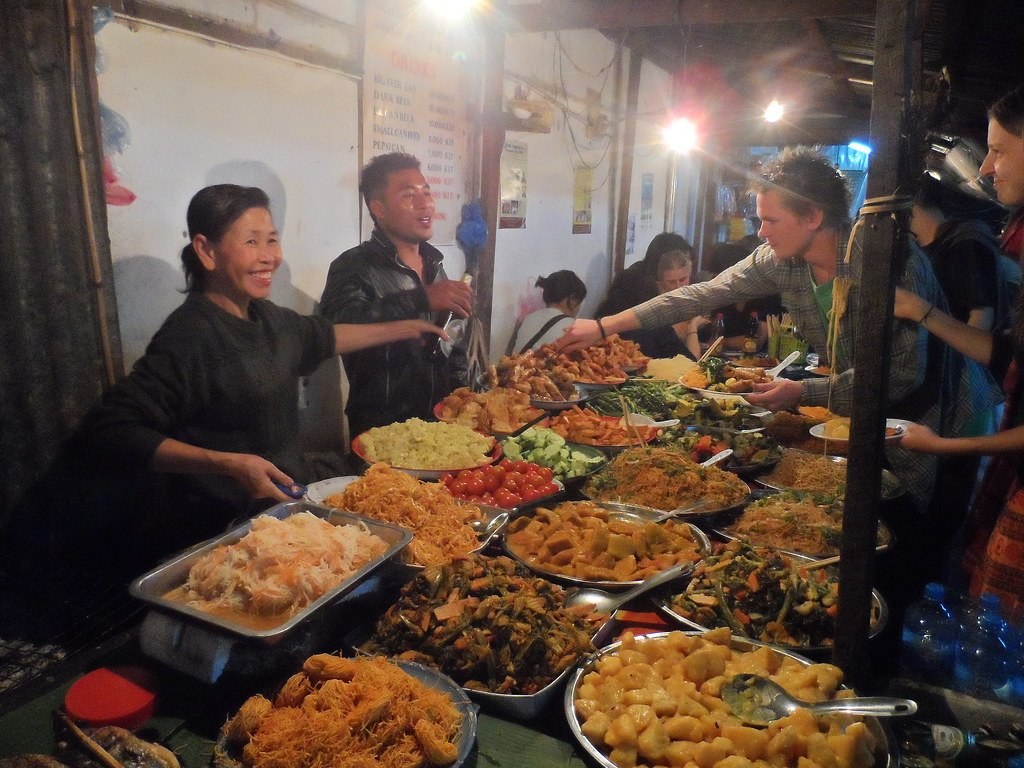
Land in Bangkok and give it three days: street food in Chinatown ($1–2 a dish), the Grand Palace ($15), and rooftop sunsets. Take the $25 sleeper train north to Chiang Mai for temples, $8 dorms, and khao soi curry noodles at $1.50 a bowl. Week 1 spend: about $200 including the train. Prices, neighborhoods, and the full cost breakdown live in our Thailand budget guide.
Bangkok savings start at the airport: the Airport Rail Link runs into town for about $1.30 against a $12 taxi. Sleep near the old town or a BTS stop rather than on Khao San itself, and hit the Grand Palace at the 8:30am opening in proper dress — cover-ups rent for $2–3 at the gate and the queue triples by 10. In Chiang Mai, the Sunday Walking Street handles dinner and souvenirs in one $6 evening.
READ MORE: Thailand Budget Guide: Daily Costs, Food & Transport
Week 2: Laos — the slow boat and Luang Prabang
Cross at Chiang Khong/Huay Xai and board the two-day slow boat down the Mekong (about $35, plus a $10 guesthouse in Pakbeng midway) — one of the great budget travel experiences. Luang Prabang rewards three slow days: $12 guesthouses, the $2–3 night market food alley, and Kuang Si Falls at $2.50 entry. Continue to Vang Vieng ($10 riverside bungalows, $20 kayaking day) and Vientiane. Week 2 spend: roughly $180. The Lao visa on arrival is $30–40 depending on nationality.
Slow-boat tactics: buy the ticket at the Huay Xai pier rather than from Chiang Rai agencies, and board early to claim a cushioned seat midship, away from the engine. Carry $10 of snacks and water plus enough kip for Pakbeng, whose ATMs deserve no trust. In Luang Prabang, the sunrise alms-giving is free to watch respectfully from across the street, and the $2.50 climb up Mount Phousi at sunset is the town's best-spent money.
Week 3: Vietnam — Hanoi to Ho Chi Minh City
The overnight bus from Vientiane to Hanoi is the route's one endurance test: 20+ hours for $25–35. Vietnam repays it instantly — $1.50 pho, $0.30 fresh beer on Hanoi's corner stools, and $12–18 private rooms. Do a Ha Long Bay day trip ($45–55 with lunch), then ride the Reunification Railway or open-tour buses south through Hoi An ($20 sleeper bus) to Ho Chi Minh City. Week 3 spend: about $230 including the big bus legs. Get the e-visa online beforehand ($25). Our Vietnam budget guide has the full city-by-city numbers.
Two softeners for the big bus: pay the $10 premium for the VIP sleeper over the seated service — it matters enormously at hour fifteen — or check flights, which sometimes drop to $60–80 and buy back a full day. Once in-country, the cheap add-on is Ninh Binh, "Ha Long on land," at $6 by bus from Hanoi, and in Hoi An the hotel's free bicycles reach An Bang beach in fifteen flat minutes.
Week 4: Cambodia — Phnom Penh and Angkor
Cross from Ho Chi Minh City to Phnom Penh by direct bus ($15–20, visa on arrival $30). Two days in the capital, then a $10 bus to Siem Reap for the finale: the temples of Angkor. The one-day pass is $37, the three-day $62, and a tuk-tuk driver for the whole circuit is $15–20 a day split between passengers. Hostels in Siem Reap cost $5–8, and fish amok dinners run $3–4. Week 4 spend: about $220 including Angkor. Budget $50–80 for the flight back to Bangkok, or $25 for the long bus.
Angkor tactics: buy the pass late the afternoon before — tickets sold from about 5pm are valid for the next day and usually include that evening's sunset free. Do sunrise at Angkor Wat once (leave town at 4:45am; drivers charge a couple of dollars extra), then run the standard circuit backward to dodge the crowds all morning. In Phnom Penh, S-21 and the Killing Fields together cost about $11 with audio guides — heavy, essential context for everything Cambodia.
READ MORE: Vietnam Budget Guide: What Everything Costs
Border crossings without the stress
All three crossings on this route are routine if you know the tricks. Carry crisp US dollars for visas (Laos and Cambodia take payment at the border; Vietnam requires the e-visa in advance). At land borders, ignore anyone offering to "help" with forms for a fee — the official windows are slow but honest. Overcharging of a dollar or two at Cambodian land crossings is common; stay polite, have exact change, and factor it in. Never hand your passport to a bus tout, and photograph every visa sticker before leaving the window.
The paperwork kit that makes crossings painless: several passport photos (borders want one or two each and sell you one for $2 if you're short), about $80 of the crisp dollars reserved for the two on-arrival visas, and your own pen. Photograph every stamp and sticker and store copies offline. When a bus company collects passports for group processing at the Cambodian land border, that specific handover is normal — everywhere else the answer stays no.
Where the money actually goes
For a $900 month, the honest split looks like this: accommodation $250 (a mix of $6 dorms and $14 private rooms), food $200 (street food plus a few restaurant nights), transport $150 (two sleeper trains, six long buses, the slow boat), visas $90–100, activities $150 (Angkor, Ha Long Bay, waterfalls, kayaking), and $50 of buffer for laundry, SIM cards, and the odd bucket of ice-cold beer. Alcohol is the silent budget killer — $3 a day of beers is $90 a month, so party deliberately, not nightly.
The split also shows where flexing matters: beds and food barely move between careful and careless travelers, but the activities line swings by $100 on choices alone — the $62 three-day Angkor pass versus the $37 single day, the $90 overnight cruise versus the $45 day boat. Pick your two non-negotiable splurges before landing and let everything else default to the cheap option; the month stays under $1,000 with no sense of sacrifice.
The total — and how to stretch it
Careful travelers do this route on $800; most land near $950; nobody comfortable needs more than $1,100. To trim further: sleep in dorms every night (saves $80–100), take day buses instead of flights, and eat street food twice a day — it's the best food anyway, as our tour of the region's cheap street food proves. Add a second month in Cambodia's islands or northern Vietnam and the per-day cost drops even lower, because slow travel is cheap travel.
Money mechanics for the month: carry two cards on different networks, withdraw the maximum each time — Thai machines charge about $6 per hit regardless of amount — and keep roughly $60 in small US bills as the cross-border float. Tally spending in a notes app nightly; travelers who track daily come in $100–150 under those who feel their way. And change leftover kip before leaving Laos, because nobody outside the country wants it.
Best time to run this route
The loop works year-round, but November to February is the champagne window: dry and 75–90°F almost everywhere, cool enough in the north for comfortable trekking, and the Mekong high enough for a smooth slow boat. The trade-off is peak pricing — add 10–15 percent to rooms and book the famous legs a couple of days out. March to May turns brutally hot, 95–105°F in Laos and Cambodia, and smoky in northern Thailand; if that's your slot, weight the month toward the coast. The wet season, June to October, is far more usable than its reputation — rain arrives as one dramatic hour rather than a ruined day, everything turns green, and rooms drop 20–30 percent — but know that Mekong water levels are at their worst for the slow boat in the late dry season around March–May, and central Vietnam's serious flooding lands in October and November. If you can only pick one month, pick November: dry-season weather at the front edge, before December's crowds and prices fully arrive.
What to pack for a month on the loop
A 40-liter backpack is the whole game — sleeper buses, tuk-tuks, and boat gangplanks all punish big luggage. The regional essentials:
- Four or five quick-dry outfits; laundry costs $1–1.50 a kilo everywhere and comes back folded the same evening.
- A long-sleeve layer and long trousers — for temples, mosquito hour, and night buses with arctic air conditioning.
- Sandals plus one pair of real shoes for waterfalls and the Angkor circuit.
- DEET or picaridin repellent, high-SPF sunscreen (expensive locally), and a small meds kit with rehydration salts.
- A dry bag, a padlock for hostel lockers, a power bank for the 20-hour bus, plus passport photocopies, eight passport photos, and crisp US dollars for the borders.
Our carry-on packing list lays out the full system; the one-line version is that every ounce you don't bring, Southeast Asia sells for less.
Is the route safe?
This is one of the safest long trips a first-time backpacker can take — thousands of people are on some version of it right now, and violent crime against travelers is rare in all four countries. The honest risk list, in order: scooters (the region's actual danger — ride only with a license, a helmet, and insurance that covers riding, or simply don't); drink-related misjudgment (buckets are cheap, hospital visits aren't — party deliberately, watch your drink, skip the tubing-day heroics); petty theft (phone snatching in Ho Chi Minh City, bag dips on crowded transport — use a crossbody strap and the hostel locker); and stomach trouble, which usually passes in a day if you ease into street food. Solo travelers, women included, consistently rate the region among the world's most comfortable — the hostel infrastructure means you're never actually alone unless you want to be, and the standard playbook from our solo safety guide covers the rest. Travel insurance at $40–60 for the month is non-negotiable for the scooter-and-boat lifestyle.
Frequently asked questions
Can I do the route in reverse?
Yes — Siem Reap to Bangkok works fine, and flights into Ho Chi Minh City are sometimes cheaper than into Bangkok. The clockwise version described here stays more popular because the slow boat lands early in your energy curve and Angkor makes a spectacular finale. Whichever direction, keep the one-way flow; backtracking is where budgets go to die.
Is a month actually enough?
Enough to do this route properly, yes — but it's a highlights reel, not a completist tour. With six weeks, the natural extensions are southern Thailand's islands or Cambodia's sleepy riverside towns around Kampot. What doesn't work is squeezing the same route into two weeks; you'd spend half of it on buses.
How much cash should I carry?
Keep $100–150 in US dollars hidden as your visa-and-emergency fund — crisp bills with no tears, because border officers reject scruffy notes — and withdraw local currency as you go. ATMs are everywhere on this trail; Thai machines charge about $6 a hit and Cambodian ones about $5, so make every withdrawal a big one.
Do I need vaccinations?
See a travel clinic four to six weeks before flying. Standard recommendations for this route are hepatitis A and typhoid with tetanus up to date; malaria tablets are usually suggested only for remote border regions, not the main trail. The consult runs $50–100 and is worth it for the answer matched to your exact route.