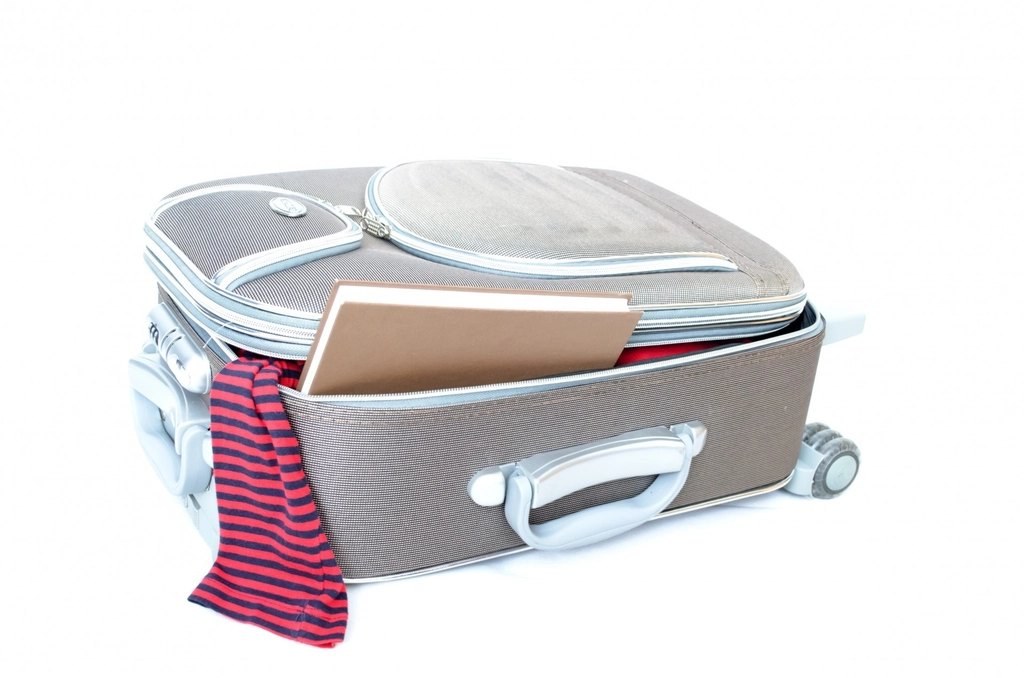
Every packed bag is a set of tiny bets about your future. After enough trips (and enough $30 airport phone chargers), we've settled on these 40 essentials — everything you actually need for one to three weeks almost anywhere, and nothing you'll haul home unworn. It all fits in a carry-on and a personal item, which means no checked-bag fees and no lost luggage. Forgetting things is one of the classic travel mistakes; screenshot this list and you're covered.
Clothes (12 items)
The rule: everything matches everything, and you do laundry once instead of packing double.
- 5–6 tops in breathable fabrics — merino blends resist odor for multi-day wear.
- 2 bottoms — one pair of comfortable pants or jeans, one pair of shorts or a skirt.
- 1 dress-up outfit for the nice dinner you'll inevitably book.
- Packable rain jacket — the $40–80 ones scrunch to the size of a grapefruit.
- Light warm layer — a fleece or packable down, even for warm destinations (planes and deserts get cold).
- 7 pairs of underwear — quick-dry fabrics let you sink-wash on longer trips.
- 4–5 pairs of socks, including one wool pair for cold or blister-prone days.
- Sleepwear you'd be comfortable wearing past a hostel roommate or hotel fire alarm.
- Swimsuit — hotel pools, hot springs, and spontaneous beaches wait for no one.
- Comfortable walking shoes, broken in before the trip — never after.
- Sandals or flip-flops for beaches, showers, and 30-second coffee runs.
- Sun hat or cap — doubles as a bad-hair-day fix.
Toiletries (8 items)
- Toothbrush & travel toothpaste — the one everyone forgets while packing tripods.
- Shampoo & conditioner bars ($8–14) — solid, spill-proof, and immune to the liquids rule.
- Deodorant — your seatmates thank you in advance.
- Sunscreen SPF 30+ — abroad it's often double the price and half the selection.
- Moisturizer & SPF lip balm — flights dehydrate skin fast.
- Razor plus a couple of spare cartridges.
- Brush or comb in a travel size.
- Microfiber towel ($15–25) — dries in an hour, packs like a T-shirt, saves you at beaches and budget stays.
A note from hard experience: decant anything liquid into 2 oz silicone bottles ($10 for a set of four) rather than trusting original packaging — hotel bathroom floors are where full-size shampoo bottles go to burst. If you run out mid-trip, pharmacies in Lisbon, Bangkok, or Mexico City sell everything above for a few dollars. The only items genuinely worth hauling from home are your specific sunscreen and any skincare your face is loyal to; both cost roughly double abroad, and beach-town minimarts routinely charge $18–25 for a single bottle of SPF.
READ MORE: Travel Mistakes Everyone Makes (And How to Avoid Them)
Tech (7 items)
- Phone + charger — download offline maps and your boarding passes before takeoff.
- Universal travel adapter ($15–25) — one with USB-C ports replaces a bag of plugs.
- Power bank (10,000mAh, about $25) — a full day of navigation and photos on one charge.
- Headphones or earbuds — noise-cancelling turns a red-eye into a nap.
- E-reader or tablet — a library that weighs 6 ounces.
- Spare charging cable — cables abandon us when we need them most.
- Luggage tracker (about $29) — if a bag goes missing, you'll know exactly where it went.
Charging strategy matters as much as the gear. Hotel rooms across much of Asia and Europe offer exactly two reachable outlets, so an adapter with three USB ports lets your phone, power bank, and earbuds all refill overnight from one socket. Keep the power bank topped up and in your daypack, never your checked luggage — airlines require lithium batteries in the cabin anyway. And sort your eSIM before you fly: $10–20 buys 5–10GB of data in most countries, activates in five minutes, and spares you the $50 airport SIM counter.
Documents & Money (5 items)
- Passport — check it's valid 6+ months past your return date; many countries refuse entry otherwise.
- Copies of everything — photos in your cloud drive plus one paper set packed separately from the originals.
- Travel insurance details — a week of coverage runs $40–80 and one clinic visit abroad repays it.
- Two cards with no foreign fees, stored in different bags, plus about $100 in USD emergency cash.
- Offline bookings — screenshots of hotel addresses and tickets for when the airport Wi-Fi shrugs.
Do the passport check tonight, not the week you fly — a US renewal costs $130, routine processing takes six to eight weeks, and expediting adds another $60. While you're at it, email yourself a scan and share a copy with someone at home. For the emergency cash, favor newer, unmarked $20 bills: money changers across Southeast Asia and North Africa reject creased or older-series notes, and crisp bills earn measurably better rates in places like Laos and Egypt.
Health & Safety (5 items)
- Mini first-aid kit — band-aids, blister plasters, pain relievers, and anti-diarrheal tablets.
- Prescription meds in original labeled containers, in your carry-on, never checked.
- Hand sanitizer & wipes — tray tables are grimmer than they look.
- Filtered water bottle (about $40) — safe tap water in more places, and no $4 airport bottles.
- Doorstop alarm or small padlock ($8–15) — cheap peace of mind for solo stays; our solo female safety guide has more.
Build the first-aid kit yourself instead of buying the $25 preassembled pouch. A zip bag with a dozen band-aids, ten blister plasters, ibuprofen, antihistamines, oral rehydration salts (50 cents a sachet and pure gold after food poisoning), and a small tube of antibiotic ointment costs about $12 at any pharmacy and covers 95% of what travel throws at you. Add motion-sickness tablets if your route includes ferries or mountain roads — Vietnamese sleeper buses and Greek island crossings have humbled stronger stomachs than yours.
READ MORE: The Best Solo Travel Destinations
Extras That Earn Their Space (3 items)
- Packing cubes ($20–30 a set) — the single biggest upgrade to living out of a bag.
- Foldable daypack ($20–35) — packs flat, then carries your camera, water, and market finds all day.
- Sleep kit — travel pillow, eye mask, and earplugs; the difference between arriving human or haunted.
That's all 40. Notice what's not here: "just in case" outfits, full-size anything, and a third pair of shoes. Ruthlessness is the whole trick.
If you have room for one more indulgence, make it a sarong or large scarf — $5–10 at any market once you land. It works as a beach blanket, temple shoulder cover, plane blanket, pillowcase, and improvised privacy curtain for hostel bunks. A handful of zip-top bags earns its place the same way: wet swimsuits, leaky snacks, sandy phones, and the receipts you'll want later all get contained for pennies. Seasoned packers aren't people with more stuff — they're people with the right cheap thing for every problem.
What does good travel gear cost?
- Budget: $50–120 — fill the gaps with cubes, an adapter, a power bank, and pharmacy-brand toiletries; use the bags you own.
- Mid-range: $200–400 — a quality carry-on, merino basics, and a filtered bottle that all last five-plus years of trips.
- Splurge: $600+ — premium luggage, noise-cancelling headphones, and a full technical wardrobe.
Buy it once, buy it right — then put the savings toward the trip itself with our budget travel hacks.
Timing the purchases matters almost as much as choosing them. Luggage and backpacks drop 30–40% during July sales and Black Friday, and last year's colorway of a $300 carry-on routinely sells for $180. Merino shirts that list at $75–85 fall to $45–55 in end-of-season clearances every March and September. Adapters and power banks hover at $20–25 year-round, so buy those whenever — just never in an airport, where the identical items are marked up to $45 and beyond.
How to adapt this list by climate
The 40 essentials are the chassis; the destination decides the trim. Swap, don't add — every item that goes in should push one out.
- Cold destinations (think Iceland or a Japan winter): trade the shorts and sandals for a merino base layer top and bottom ($30–60 each), a packable down jacket, waterproof shoes, and a beanie and gloves. Layering beats one giant parka every time — three thin layers handle 25°F to 60°F without repacking. Planning an Iceland Ring Road trip? Add waterproof pants; skip the umbrella, the wind eats them.
- Tropical destinations: drop the warm layer to one thin fleece, double the quick-dry tops, and add reef-safe sunscreen ($12–15 — required by law in places like Hawaii and increasingly scarce on small islands), a sarong, and a dry bag ($10–15) for boat days.
- City trips in Europe: upgrade one outfit to smart-casual — several famous churches and upscale restaurants enforce dress codes — and choose dark colors that hide a week of wear. Your walking shoes matter more than anywhere else: 20,000 steps a day is a normal Rome or Paris day.
Carry-on only vs. checking a bag: the actual math
Checked bags cost $35–45 each way on major US airlines and $50–75 on international budget carriers — call it $70–150 per round trip, or a full extra day of travel in half the world. Carry-on only also removes the risk entirely: roughly 6 bags per 1,000 are mishandled, and it's always the week you packed medication in the hold. But checking wins in two cases — trips over three weeks through multiple climates, and anything involving gear you can't buy cheaply on arrival (dive computers, camping kit, a wedding outfit that must not wrinkle). If you do check, put one full change of clothes and all chargers in your personal item. Future you, standing at an empty carousel in a foreign airport, will be extremely grateful.
Common packing mistakes to avoid
- Packing for the trip you imagine, not the one you booked. Two novels, four dressy outfits, a drone you'll never register — audit against your actual itinerary.
- New shoes. The single most common self-inflicted travel injury. Break them in for two weeks at home or leave them there.
- Full-size toiletries "to save money." A 16 oz shampoo weighs a pound and gets confiscated at security. Decant or buy bars.
- One bag with no organization. Without cubes or stuff sacks, every hotel room becomes an explosion site and repacking takes 30 minutes instead of 5.
- Ignoring the return journey. Leave 10–15% of your bag empty, or pack a flat duffel — markets in Marrakech and Bangkok have defeated stronger wills than yours.
Frequently asked questions
How do I handle laundry on a longer trip?
In Southeast Asia and Latin America, drop-off laundry costs $1–2 per kilo and comes back folded the same evening — build it into your week and pack half as much. In Europe and the US, a laundromat run is $8–12; hotel laundry is a trap at $4–8 per shirt. For everything else, a sink wash with a bar of laundry soap ($3) and your quick-dry fabrics covers the gap overnight.
What size personal item actually fits under the seat?
Most airlines allow roughly 17 x 13 x 8 inches — a 20–25L backpack. Budget carriers measure with sizing frames and charge $40–70 at the gate for failures, so measure your bag stuffed, not empty. A soft-sided pack that squishes beats a rigid mini-suitcase every time.
Are packing cubes really worth it?
Yes, and it isn't close. Beyond the space savings, they turn your bag into drawers: one cube for tops, one for bottoms, one for dirty clothes. At $20–30 for a set that lasts a decade, they're the cheapest quality-of-life upgrade in travel. Compression cubes add another 20% squeeze for bulky cold-weather trips.
What should never go in a checked bag?
Passports, medication, electronics, chargers, jewelry, and anything you'd genuinely mourn. Airlines explicitly exclude valuables from compensation claims, and lithium batteries are banned from the hold anyway. The rule of thumb: if losing it would change the trip, it rides with you.
How heavy should my bag actually be?
Aim for 15–20 pounds all-in. Budget airlines cap carry-ons at 15–22 pounds and do weigh them, but the better reason is your own back on a cobblestone hill at midnight. A $10 luggage scale ends the airport guessing game forever — weigh before you leave home, and again before the flight back with all those market finds aboard.